Special Edition Day 11 May 18, 2001
_____________________________________________________________________________________
The Fort Edwards Archaeologist
_____________________________________________________________________________________
Report on the Archaeological Excavations at Fort Edwards, home site of Joseph
Edwards and a French and Indian War frontier fort of Col. George Washington.
This archaeological excavation is part of the ongoing project of The Fort Edwards Foundation of Capon Bridge, West Virginia, to preserve, protect and iterpret the home site and fort site at Joseph Edwards's land grant on the banks of the Cacapon River in Hampshire County, West Virginia. This site represents both an early settler's home of the second quarter of the eighteenth century and a French and Indian War fort in Col. George Washington's chain of forts protecting the Virginia frontier. The excavation is under the direction of Dr. Stephen McBride of Wilbur Smith Associates of Lexington, KY. This page is one of a series of reports on the work.
___________________________________________________________________________________
Day Eleven - Covering Up
Plastic Wrap
The Decision was made to continue the work for a few more days. The eleventh day of the dig began with the preparations to cover most of the excavations. The fact that we were coming to the end of the project and the expectation of rain over the next few days dictated that we prepare to cover our excavations. Keith cut plastic sheet in small pieces to cover individual features in the backhoe trenches.


Although each feature is mapped precisely so it can be found, each feature needs to be protected by a layer of plastic sheet before dirt is placed on it. In the future, if we need to reinvestigate that feature when we dig on the spot the map indicated, we will come to the plastic before we inadvertantly cut into the feature. It should then be in as good shape as it is today when we last see it before it is covered. Today we covered a good portion of the excavations leaving only those features we still wanted to work on in these last few days.

Last Draw
In the few spots that the front loader had not covered trenches Cathy was drawing the features. Once she finishes recording them those spots can be closed. At some later date they may be reopened if we feel the need to expand our investigation of the area they are in. These look like two post marks. Maybe some day we will try to determine if they are post marks and if any more are nearby.
House Foundation

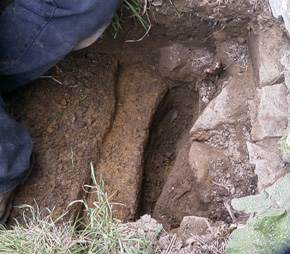

Keith spent a good amount of time trying to find out about the house foundation. The first picture shows a test probe placed along the foundation wall to see if there was a "builder's trench" dug when the foundation was built. While Cathy sifted the dirt looking for artifacts that might have fallen into the trench while people were building the wall, Keith continues to dig deeper. By later in the day he had gotten near the subsoil (second photo).
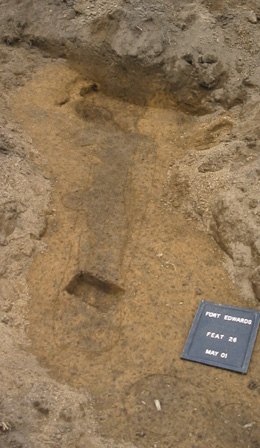
Feature 26
Another of the features that was not buried so that we can continue to study it was Feature #26. This is a line (like a stockade trench) that lies near Dr. Gardner's stockade trench and runs roughly parallet to it. What its purpose is we do not know. Another of the many mysteries that we will have to work on later.
Fallen rocks?
 The major area that we left uncovered was the area of the new bastion feature and the nearby cellar feature. Here (to the right) we see the area of the cellar as it appeared in the morning. During the day Kurt worked to reveal more of the rocks (see picture below). We do not yet know what it represents, but it may be a fallen chimney or just rubble from a foundation of a fallen house as the cellar hole was filled in. Again, there are so many questions and so few answers.

Artifacts of the Day
 Today's artifact was quite a find. At a fort you would hope to find some gun parts. We found this French flint in almost perfect condition. It is rather large suggesting that it may be from the type of gun called a "Brown Bess". This is what the Virginia Regiment would most probably have been issued from the Governor's arsenal. The flints on these guns were larger than those used on the fontier hunting rifles. For information on French flints go to Artifact of the Day on the May 14th page
Volunteers of the Day
Since this day was not scheduled, we had no regular volunteer signup. However, we owe thanks to Jim Cawley and Greg Adamson who found out about the extention and contributed time to us today. Gentlemen, it was above and beyond the call of duty. Thank you. We will not be using volunteers in these last few days.
The Schedule
We are not sure how long we will be working. The expectation is for three more days, but the weather is an uncertain factor. There are storms moving into West Virginia tonight. How severe these are and how long they last will determine if we can work in the next few days. Stay tuned.
