 |
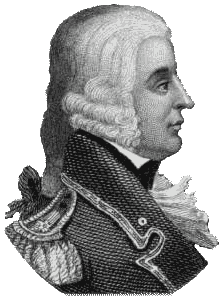
Maj.
Gen. Edward Braddock
General
in Chief of His Majesty's Forces
in North America
|
Who Would Have Thought?
A
Series Commemorating the
“Season of Braddock”
in the
French and Indian War 250th Anniversary

Part
IV Running into Disaster
Once
the army left Fort Cumberland the real test began. If they thought that
the creeks and rivers and forests of Frederick and Hampshire Counties
were troublesome, they found the western wilderness had those aplenty
and far more challenging terrains with names like “Shades of
Death.” If they thought that Spring Gap Mountain was
difficult, it paled in comparison with the Allegheny front and ridge
after ridge of unmapped mountains that often made splinters of the
wagons. If they thought that their security plans had been proved
earlier, they were dismayed that any day in this wilderness home to
Indians they could loose a few stragglers and scouts. And if they
thought that they had plans to best utilize the small number of horses
and wagons to move their vast train, they found that often they could
move only three or four miles a day with the end of their line just
leaving camp as the front was just arriving at the next one.
Conquering
the Wilderness
But
here is where General Braddock managed to overcome nature’s
difficulties in the most challenging military effort America had seen
since the travels of the conquistadors in the early south and west.
Where the planners in London were totally unaware of what those lines
on their maps meant, Braddock faced and overcame the reality on the
ground. It was a great victory especially when one considers the army
he was moving.
There
was a core of trained British regulars (admittedly not the best that
Britain had to offer), but the rest of the army were recruits mostly
from the American tidewater who had never faced such terrain and
wagoneers who had never tasted discipline. It is amazing that Braddock
did as much as he did given what he had to work with.
Advancing
with a Flying Column
The
real test of an army, however, is battle, and that was almost upon
them. When it became apparent that the slow progress put the army in
danger of finding reinforcements at Fort Duquesne, Braddock took
council and divided the army into two sections. He moved with the
advance part composed of the best regular troops, his few Indian
scouts, the frontier scouts, the colonial soldiers and part of the
artillery - about 1400 men. This flying column was designed to be the
“fast attack force” while Col. Dunbar was left with
the bulk of the supplies and enough soldiers to guard his section that
was the slowest to advance.

Fort Duquesne was an imposing fortification that would require siege
works with cannons to destroy. Gen. Braddock needed a substantial force
for the task.
Photo
of model at Fort Pitt Museum, Pittsburgh, PA |
As the
flying column approached the objective, Braddock cautiously scouted the
terrain and planned a route best suited to keep his army from the
possibility of ambush. On July 9th he crossed the Monongahela River
twice, each time sending the Grenadiers first to clear and protect the
crossing. When the second crossing was complete, the army thought the
prize was theirs since they knew the French could not withstand an
artillery siege of the wooden fort. The band struck up a tune, and the
final march of about seven miles began with Col. Gage’s men
in the advance.
The
French Review Their Options
The
French, of course, had been well aware of Braddock’s every
move. Their scouts had closely followed the enemy’s advance.
Capt. Claude-Pierre Pecundy, seigneur de Contrecour, the
fort’s commander who had accepted Ensign Ward’s
surrender of the small British fort at the Forks on April 17, 1754, was
now preparing to surrender this strategic location back to the British.
Although he had a force equal to Braddock’s, he knew that a
wooden fort was no match for Braddock’s artillery. He also
knew that Indians would never stay for a siege. But there was another
option.
One of
Contrecour’s subordinates, Capt. Daniel Lienard de Beaujeu,
offered to lead an ambush of the British, hoping that this might
discourage the enemy or at least give the French more time to await
additional men. Contrecour, without much other hope, gave Beaujeu half
of his force, just over 250 French and Canadians and some six hundred
Indians. Beaujeu had to spend much valuable time convincing the
Indians, who only took to the battlefield when the odds were in their
favor, that this was an opportunity for victory and plunder. Finally,
Beaujeu’s eloquence won the Indians, and they started out to
try to beat the British to the final ford of the river. They were too
late.
The
Battle Begins
At just
past one o’clock in the afternoon, Lt. Col. Gage’s
men first spotted the French. The armies had literally run into each
other in the forest. The British were marching in good order with the
advance party on the lookout and scouts guarding the flanks. The French
and their Indian allies were running through the woods hoping to get to
the river before the British had completed their crossing.
There
were a few war whoops and some shots before the British managed to form
up into their standard firing order and deliver a volley. The effect
was immediate. Beaujeu fell dead, shot through the head. The Indians
scattered. The British brought up a cannon and delivered another volley
from the infantry. The enemy was in disarray. After three volleys from
Lt. Col. Gage’s men the field seemed to belong to the British.

Facing
the Enemy
But now
both armies did what they did best. That would determine the victor.
The French officers were each trained differently than the British.
They had lived among the Indians in the wilderness until it was their
home. They knew their allies and held their respect. They could easily
command in such a situation. Capt. Dumas, the second in command,
immediately stepped forward and ordered his men to flank the British
line.
The
Indians for their part took to the trees and natural defenses.
Unfortunately for the British, the point of battle was a ridge with
small ravines on each side and a hill to the front right. The Indians
and Canadians ran along the ravines safe from fire until they could
find a tree or other natural cover and began to pick off the British,
especially the officers.
Compressed
Confusion
“…the
front was attacked; and by the unusual hallooing and whooping of the
enemy, whom they could not see, were so disconcerted and confused as
soon to fall into irretrievable disorder. The rear was forced forward
to support them, but seeing no enemy, and themselves falling every
moment from the fire, a general panic took place among the troops, from
which no exertions of the officers could recover them.”
George
Washington
|
Col.
Gage tried several times to take the hill to the right, but was
rebuffed. Finally, his forward column had to move back. This is when
the British lost the day. As Gage and the forward companies moved back
they ran into the troops that Braddock was ordering forward to support
Gage. All these men were confined to the twelve foot wide road or
perhaps to areas a bit larger where the openness of the forest allowed.
However, even this was insufficient for the trained British soldiers to
be able to form their lines of fire and effectively engage the enemy.
The British simply huddled in masses and fired indiscriminately, their
fire often killing the colonials who had taken to the trees or other
British who happened to be in the way although hidden by smoke.
Braddock
and his officers displayed the best that could be expected of them, but
this turned to their disadvantage. With their bright uniforms, their
gleaming gorgets, often mounted on horses, they made perfect targets.
Their courage was acknowledged by all, but it cost dearly. Out of 82
officers, 63 were killed or wounded. Braddock himself had five horses
shot from under him before he was mortally wounded, and George
Washington had two horses killed under him and four bullet holes
through his uniform.
Fear
Defeats an Army
With
their general wounded, most officers killed or incapacitated, and the
whoops of the Indians all around them, the soldiers gave way to panic.
Amazingly, they had withstood the onslaught for almost three hours, but
now nothing could stop their flight. Leaving not only the wounded on
the field, but even their guns and food, the men took to flight that
lasted through the night.
“"This
[forward] guard being disordered, the general hurried the troops up to
their assistance, which was done in great confusion through wagons,
baggage, and cattle, and presently the fire came upon their flank. The
officers being on horseback were more easily distinguished, picked out
as marks, and fell very fast; and the soldiers were crowded together in
a huddle, having or hearing no orders and standing to be shot at till
two thirds of them were killed and then, being seized with a panic, the
remainder
fled with precipitation."”
Benjamin
Franklin
|
Next
Time: Winter in August - the
retreating army leaves the frontier open to
enemy attacks.
Timeline:
- June
8th Finally, the army leaves Fort Cumberland through the Narrows.
- June
24 First camp after the Great Crossing of the Youghiogheny
- June
27 Army reaches Gist’s Plantation, burned by the French the
previous year
- July
9 The Battle of the Monongohela
- July
13 General Edward Braddock dies of his wounds and is buried in the road
to obscure all trace of his grave from scavaging Indians.
For
further reference see:
Monongahela
1754-55: Washington’s Defeat, Braddock’s Disaster
by Rene Chartrand; Opsrey Publishing, Oxford, England, 2004. This
newest book on Braddock's defeat is profuselyn illustrated with
sketches, photos and maps. The Canadian author gives the
French/Canadian perspective of the battle.
Braddock
at the Monongahela
by Paul E. Kopperman; Pittsburgh, University of Pittsburg, 1977. This
is a unique, detailed study of the various contemporary and
near-contemporary accounts of the battle that attempts to discern the
credibility each account merits.
Go to: Part V Previous
Part III

|

